


Episode 12: Retail ETFs; Venue Selection Matters
As we noted in the previous episode of Liquidity Matters, European retail trades in ETFs execute at or better than the reference Best Bid Offer ‘BBO’ on 80% of occasions, normally by reference to the venue of the main listing. By value traded, this is a similar proportion and 53% of traded value executes inside the spread. To investigate where the 20% shortfall arises, we look at individual venues and find that only five achieve the benchmark for 100% of value traded which collectively account for just 6% of value traded. The remainder range from 85% to as low as 14%.
We took the top 10 most actively traded retail ETFs for the last 60 days, and classified every execution from the last 60 business days as either at, within or outside the BBO market quote. We classed venues with 100% BBO execution rates as ‘Group 1’ and the remainder as ‘Group 2’ or ‘Group 3’ depending on the level of BBO adherence. We ran the analysis across all 16 major European venues, with multi currency ETFs treated separately since currency typically determines which venue acts as the reference market.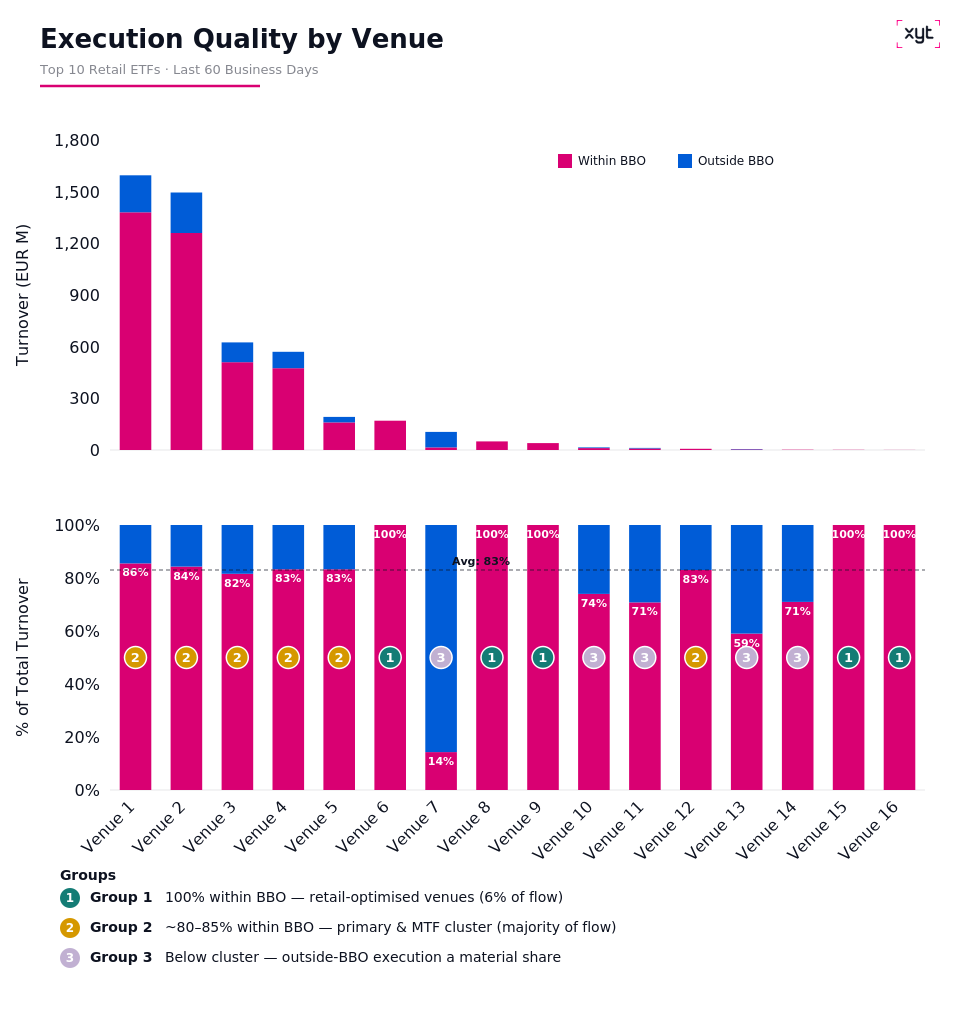
Figure 1: Execution quality by anonymized venue. Top panel: turnover (value traded - €Bn. Bottom panel: percentage split, inside and outside BBO.
As shown in Figure 1, the result is not a uniform picture. European venues fall into three distinct groups of execution quality - plus one notable outlier. Group 1 (five venues) achieves 100% of value executed at touch or better than the BBO, Group 2 (six venues) cluster near the 80% mark, and Group 3 (five venues) fall short ranging from just 14% to 74%.
Volume concentration matters
A critical detail: the group structure does not align neatly with venue size. Some of the highest-volume retail venues sit in Group 2, not Group 1. This means that by value, the majority of European retail ETF flow executes on venues where some one in six trades are executed outside the BBO spread.
If the same flow were routed to Group 1 venues would the the proportion executing outside the BBO still be close to zero? The gap between Group 1 and Group 2 is not random, it is measurable, persistent, and significant in aggregate. So why do these gaps arise?
Market model and competition. Venues differ in how they source and display liquidity. Some operate open order books with multiple competing market makers. Others rely on a single specialist and a quote-driven model. The degree of competition for each order directly affects where it executes relative to the BBO quote. There are differences in fee structures, which ultimately may benefit the investor depending on how they are charged by their brokers. Price update lags caused by latency can result in trades executing outside the touch of a remote venue used as the reference BBO.
Reference price mechanisms. Some venues are required by regulations to execute within the spread of a reference exchange. Others make no such commitment. And even where a reference price rule exists, the definition of "within" and the handling of edge cases - stale quotes, fast markets, after-hours sessions - differ between venues.
What this means for brokers
Under MiFID II, brokers carry the best execution obligation. The choice of execution venue is a core part of that obligation, and the data shows that not all venue choices deliver equivalent outcomes.
For brokers routing retail ETF flow, the question is concrete: in which group do your selected venues sit?
This does not mean one venue is categorically "better" than another. Total cost of execution includes fees, settlement costs, speed, and certainty of execution alongside price. But price relative to the reference market is the single most visible dimension for retail orders, and the data shows clear, consistent, and tiered differences.
Conclusion: Why independent measurement matters.
Venues publish their own execution quality statistics, and brokers produce their own best execution reports. But these are, by definition, not independent. A venue has every incentive to present its execution quality favourably. A broker is motivated to justify their routing decisions.
Our data shows a cross-venue, independent view that applies the same methodology to every trade on every platform - using the BBO market quote convention as a consistent benchmark. That is what this analysis provides.
The three-group pattern we observe is not a judgement. It is a measurement. And in a market where retail participation is growing and PFOF is banned, and best execution obligations are under increasing regulatory scrutiny, independent measurement is what the industry needs most.
Follow us on LinkedIn to stay up to date with the latest series of Liquidity Matters, news and platform enhancements.