


Episode 11: Shining the light on retail flows
Are Europe's Retail ETF Investors Getting a Fair Deal?
Retail participation in European ETFs has never been higher. Total intraday retail trading in the top 10 European ETFs has so far this year exceeded €24bn, and that is just for trading on electronic venues. This flow is sourced primarily from an expanding number of ease-of-access wrapper account providers. So-called 'neo-brokers' are lowering barriers to entry, and passive investing has become a retail habit. Exchanges are introducing new trading mechanisms to improve efficiency and liquidity.
But as more retail money flows into ETFs, a fundamental question poses a significant data challenge: how good is the execution quality experienced by consumers? We find that 53% of retail trades for under €50,000 in the top 10 most liquid ETFs receive price improvement when benchmarked using the Primary Best Bid Offer (PBBO), while 80% receive the touch or better. But that still leaves 20% traded at a premium to the PBBO.
The transparency challenge
Under MiFID II rules, brokers are obliged to deliver best execution for their client. But the definition remains subject to interpretation. For institutional flow, the measurement tools, governance and processes are well established. But retail execution quality is an area where the industry has been reaching for clarity in the past few years. Retail trading does not benefit from comprehensive venue access and smart order routing in the way that institutional trading does, and the microstructure is not consistent across regulatory jurisdictions (for example there are many regional platforms available in Germany for Xetra based listings, while the Retail Service Providers network adds a UK nuance). ETFs represent a particular challenge as the same asset is tradeable in many different countries.
The problem is not that the data doesn't exist. All trades leave their footprints. The challenge is connecting them to meaningful context. Does the answer change depending on the size of the trade, the liquidity of the ETF, or the time of day? How do we handle reporting time lags and price propagation lags across alternative venues? By using the primary exchange's PBBO as a benchmark to study execution quality, we can cast light on these questions.
Matching trades to quotes
The methodology behind our Retail ETF Execution Quality analysis is conceptually straightforward. By analysing trade reports in microscopic detail, we identify retail-sized trades across European ETFs and compare each execution price against the prevailing best bid and offer on the primary listing exchange (the PBBO) at the moment of the trade.
Figure 1 illustrates this methodology. Every trade is classified into one of five categories:
Above Offer or Below Bid; the investor paid a premium for the trade, possibly because the order exceeded available liquidity at touch
Within Spread; the investor received price improvement relative to PBBO
At the Offer or At the Bid; the investor sold at the primary bid or bought at the primary offer.
By segmenting this analysis across trade size thresholds, we see how execution quality varies with order size. This is a critical dimension, since smaller orders should enjoy higher price matches to the PBBO.
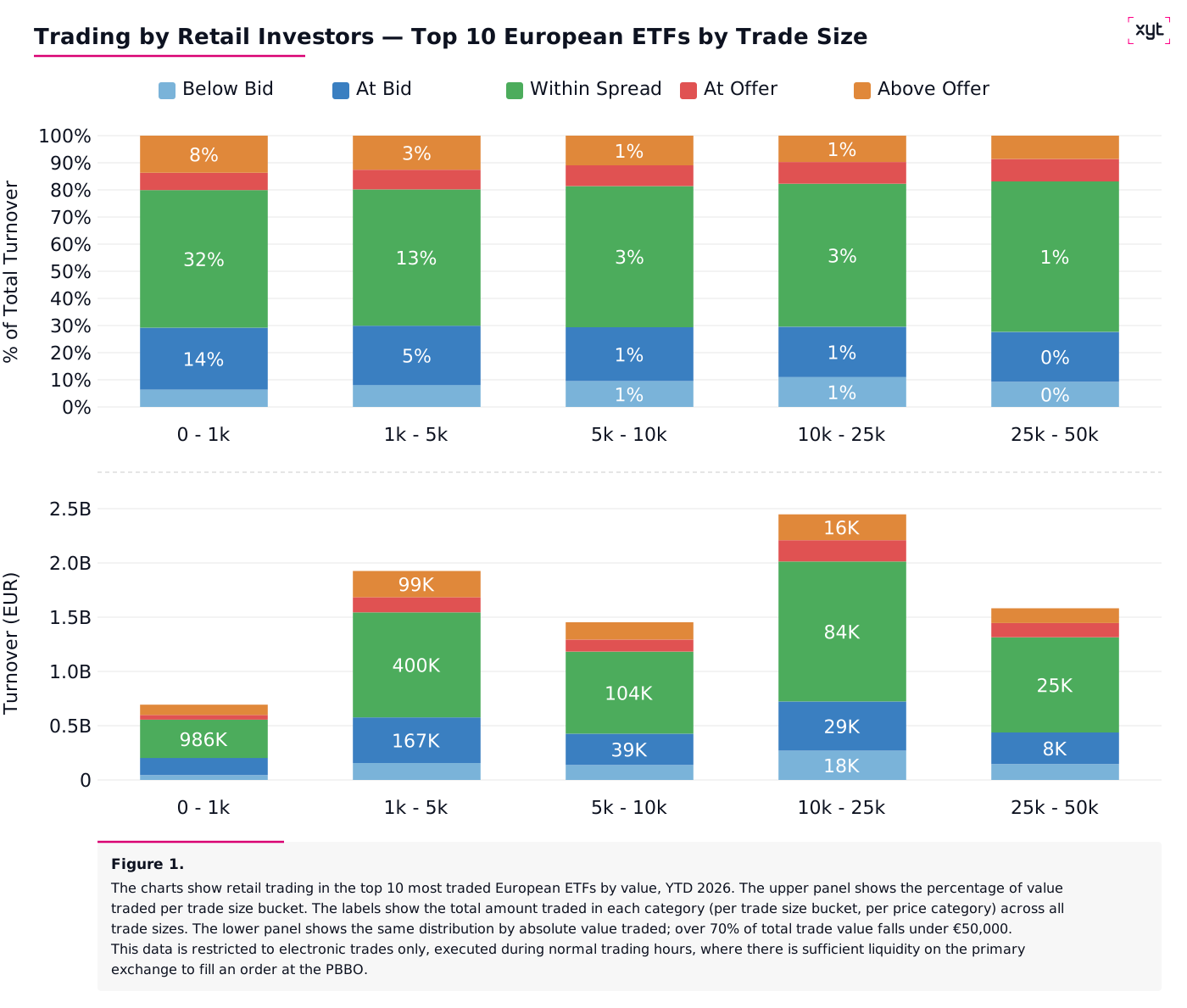
Overall, the analysis reveals that 80% of traded value is executed at touch or better, and 53% is executed with price improvement. Intriguingly, the proportion of execution outside PBBO is similar across the trade sizes, implying that trading on non primary venues may be systematically outside of the PBBO. It is the 20% of traded value outside the touch that requires deeper analysis.
Deep Dive on SWDA - The Most Traded Retail ETF
Analysis on the widely held iShares Core MSCI World USD (SWDA) is shown in Figure 2, using 2026 trading data.
We measure the trade-to-quote distance meaning how far the execution price was from the relevant side of the primary market quote expressed in basis points. A positive 'distance' means price improvement and a negative distance means the investor paid a premium. The analysis assumes that retail orders are inherently spread crossing and that passively placed orders (such as stops) will execute at the top of the book in all cases.
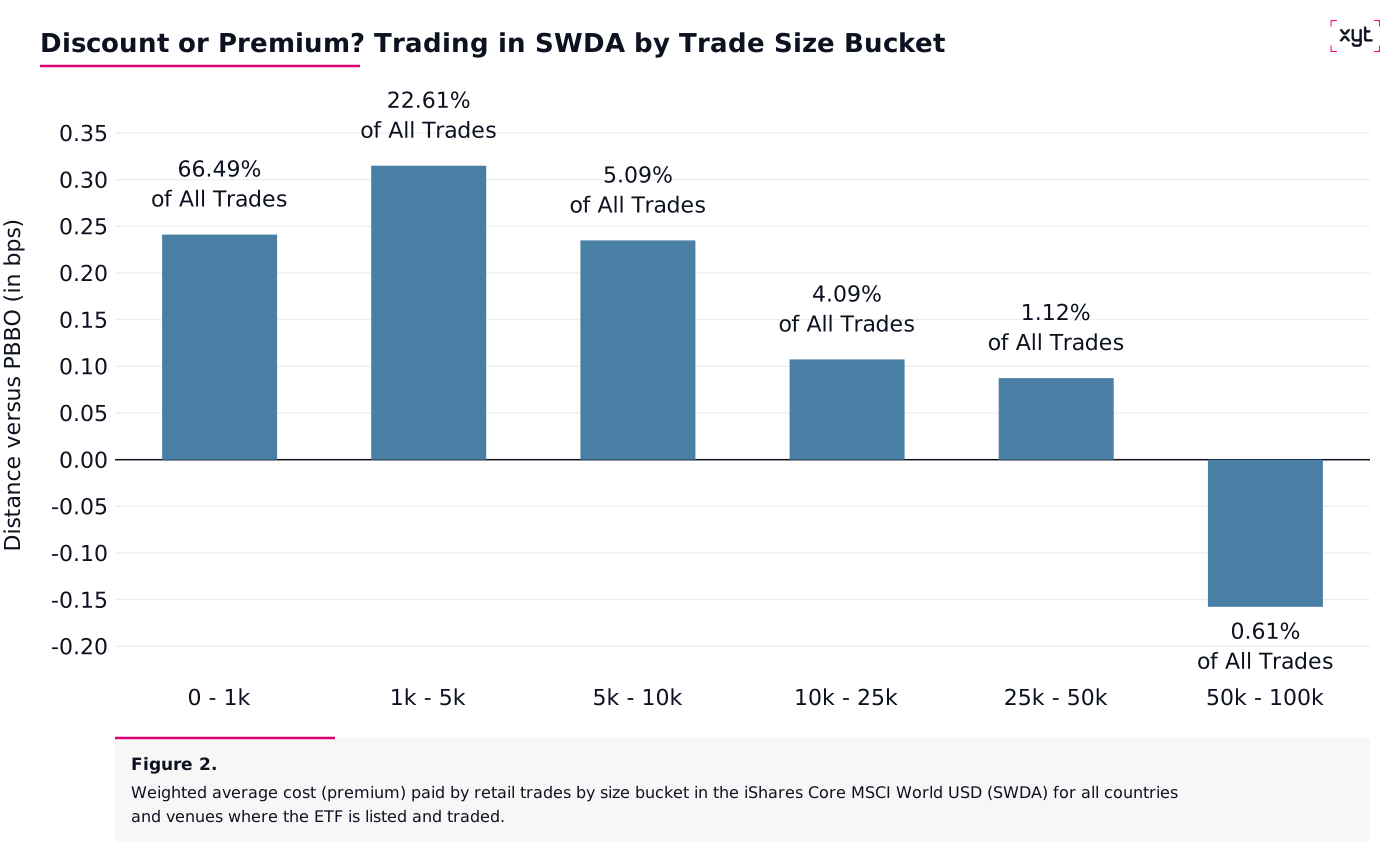
Most retail trades execute at or within the primary spread; 99.4% of all retail trades of value €100k or less execute within the primary spread. Trades of €5k or less make up 89% of all retail trades and receive between 0.25 and 0.3 basis points price improvement. This picture is stable for trade sizes up to €50k and even up to €100k the slippage is only 0.16 basis points on a value weighted basis.
Execution quality is not uniform across trade sizes. How is it possible for there to be any trades executed outside the PBBO? The answer is that not all trading venues match the PBBO so that some trades, and especially larger trades, execute at a worse price. Just as with institutional orders, it is vital to monitor trading performance across all available liquidity pools to comprehensively monitor price quality.
These patterns are not unique to SWDA. They repeat, with variations, across the European ETF landscape. The shape of the curve changes with liquidity, asset class, and trading currency, which is precisely why a systematic, data-driven approach matters more than anecdotal observation.
Why this matters now
Several industry trends make this analysis increasingly relevant.
The Payment For Order Flow (PFOF) debate has sharpened scrutiny on retail execution. With payment for order flow banned or restricted in several European jurisdictions, the conversation has shifted from "who is paying for your order flow" to "what quality of execution are you actually receiving." Data-driven answers are now expected, not optional.
Brokers need evidence. Best execution policies are only credible when they are backed by measurable outcomes. A broker claiming to deliver best execution for retail ETF orders needs to demonstrate it, ideally with independent, venue-level data that goes beyond their own internal reporting.
Investors are paying attention. Retail investors today are more informed than any previous generation. They read about spreads, compare broker offerings, and ask pointed questions on forums and social media. Execution quality is becoming a competitive differentiator.
Conclusion
Retail investors have greater market access than ever before and greater access to investment information than ever before - not always of the highest quality. Consumers are managing their pensions and investments through electronic platforms. Execution quality and trading cost matters as much to this segment of the market as for institutional investors.
Our example shows the power of forensic analysis for retail trading which can be applied systematically across the full European ETF market - covering the LSE, Euronext, Xetra and all other primary exchanges, regional exchanges and alternative venues, spanning thousands of ETFs across equities, fixed income, commodities, and thematic exposures.
Venues, brokers and market makers now have the tools to demonstrate the quality of their retail execution with independent, verifiable evidence. In an environment where regulatory obligations and commercial credibility demand transparency, that evidence base is no longer optional.
If you'd like to explore the Retail ETF Execution Quality dashboard or discuss how it applies to your flow, get in touch.