


Episode 10: Does Latency Matter?
As shown throughout the Liquidity Matters series, price discovery in fragmented markets is challenging. Liquidity and prices emerge from many sources. Even finding and reacting to the best price across fully transparent lit order books requires technology capable of operating at the microsecond level. Prices diverge and realign as participants compete across the primary country exchanges and three main MTF order books to capture spread. A price change that narrows the EBBO spread on the LSE is fully reflected on the MTFs within 300 microseconds, for 60% of occurrences. For Euronext Paris, this takes 3,600 microseconds. For Madrid, 9,700 microseconds. Other countries fall between these points, and the effect is symmetrical - the same lag occurs on an exchange when a new price originates on an MTF.
When an order appears on a lit trading venue that improves the bid or offer shown across all lit trading venues, it sets a new EBBO. This occurs when a participant seeks to capture aggressive counter-directional orders by starting a new queue on a better price level. If other participants view the new price as fair, they may join the new queue on the same order book or start a new queue on an alternative lit trading venue. The alternative venue therefore ‘regains’ the EBBO. If no other participants react to the new price it will fade, meaning that EBBO regains don’t happen in every case, and materialise at different speeds. This can be a measure for the market’s conviction at the new price. This is price formation in action - where participants and liquidity providers propagate prices across fragmented infrastructure.

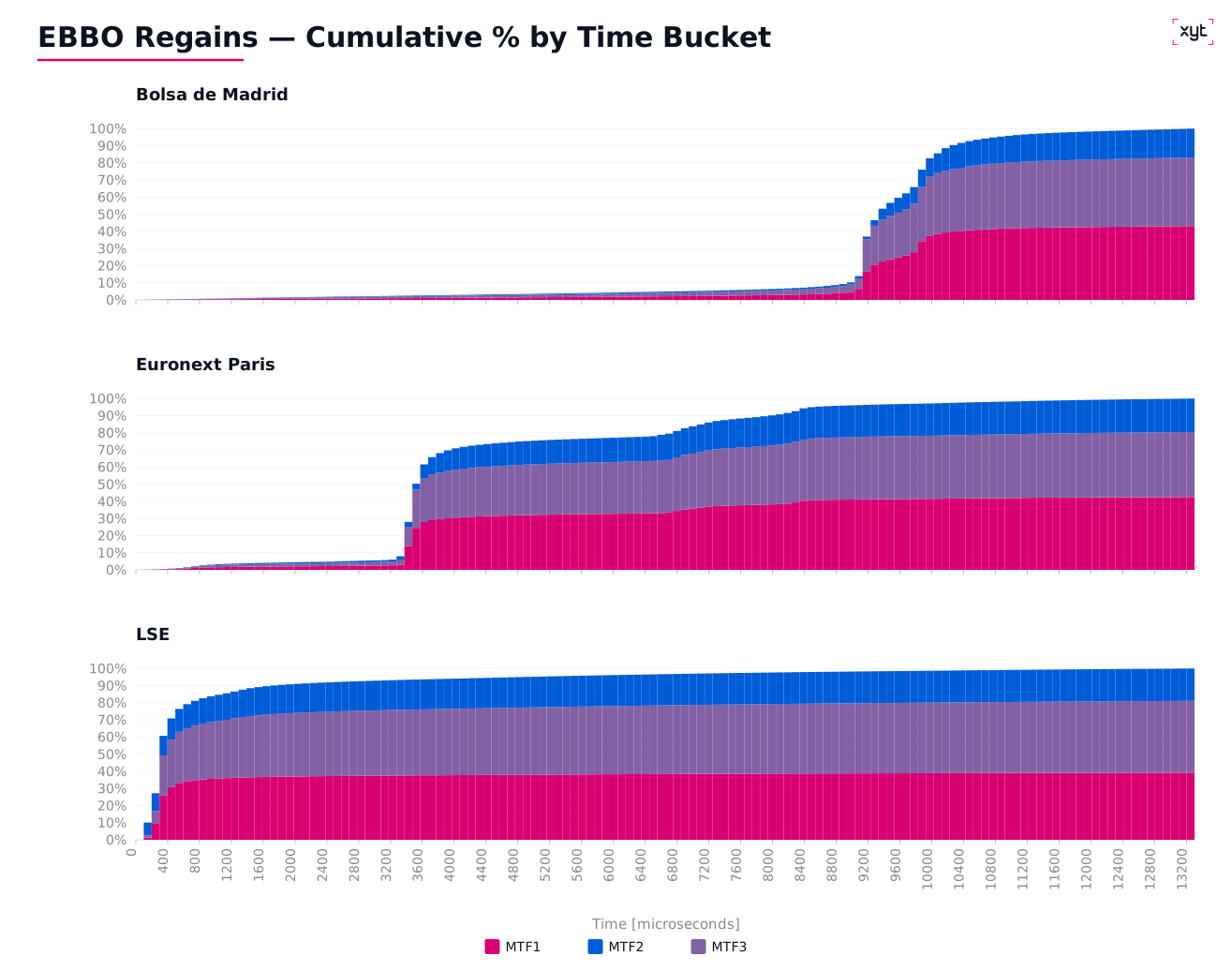
 Figure 1: EBBO Regains for most liquid stocks listed on LSE, Paris and Madrid in microseconds. An EBBO Regain is where an MTF ‘catches up’ with a new price shown on the primary exchange. The chart shows the cumulative latency of the regain per bucket in 100 microsecond increments.
Why is there a difference between the latency of EBBO regains for London, Paris and Madrid? MTF matching engines are located in London. Primary exchange matching engines either operate in their respective countries or at a hub location for multi-country exchanges like Euronext where the data centre is near Milan. The difference is largely dictated by distance. The Euronext matching engine operates approximately 950 km from London; Madrid's primary engine is ~1,250 km from London.
Speed of light transmission contributes approximately 6,250 microseconds one-way from Madrid to London. For Madrid, 60% of regains complete within 9,700 microseconds, with difference in time generated by venue matching engines, network infrastructure and the decision making process of electronic trading and quoting algorithms as they decide whether and where to change a quote. Without the geography involved, the figure of 300 microseconds for London indicates the astonishingly low latency at which the market reacts to new information on price.
Although latency differences are tiny, they affect routing decisions. Consider a smart order router that sends a passive limit order to wait in a queue on one order book, only to see a better price appear elsewhere, setting a new EBBO. The router faces a decision: does it cancel and join the new queue? By the time the router reacts, the new queue is likely to be longer. Missing execution by staying increases the risk of needing to pay the spread to catch up.
For dark pools specifically, regulation requires execution strictly at the mid-price of the reference venue, (typically the primary exchange) with highest traded value. The dark pools operate as MTFs, and are mostly also based in London. Latency in EBBO propagation means dark pool trades may not execute precisely at the current EBBO mid-price, particularly for distant primaries.
Conclusion
We showed in Episode 9 of Liquidity Matters that implicit trading costs measured through mark-outs differ substantially by listing location, with particularly notable differences for dark pools between London and Madrid. EBBO propagation latency substantially explains these differences. The ~1,250-kilometer distance from Madrid to London creates an ~6,250-microsecond floor from physics alone, with additional infrastructure and processing latency bringing total EBBO regains to ~9,700 microseconds for 60% of updates. London's colocated structure reduces distance, resulting in 300-microsecond EBBO Regains - indicating latency due to ‘decision making’ speed.
This is a structural feature of current European market design. Participants operating across geographies manage the challenge through algorithm precision and sophisticated order routing. Measuring execution quality must distinguish between performance due to decision making, data quality and routing logic versus raw geographic latency effects. High granularity, nanosecond data lies at the heart of the solution to this challenge.
The introduction of a Consolidated Tape this year will establish an official EBBO of record. The aim of the initiative is to reduce the cost and effort involved in monitoring price formation and checking adherence to best price on a post trade basis.