


Episode 1: Why Addressable Liquidity Matters
Headline trading volume figures routinely overstate the magnitude of liquidity available to investors, and by as much as €28bn euros per day in Europe based on 2025 data. This is 32% higher than the amount investors can reasonably rely upon for estimating trading costs and for investment decisions. The industry refers to the more precise notion of Addressable Liquidity. In this episode, we describe this concept and why it matters.
The discrepancy of 32% is illustrated in the chart below, which introduces the difference between ‘On Order Book’ trades (in blue) and ‘Off Order Book’ trades (in green). In this episode, we will expand upon this high-level definition of On and Off Order Book trading, which forms the foundational structure of the European equity microstructure as enforced by regulation.
The left chart shows headline volumes of €115bn Average Daily Value Traded ‘ADVT’; with just 45% traded on the order book. The right chart shows the adjusted number for Addressable ADVT of €87bn, with 60% traded on the order book.
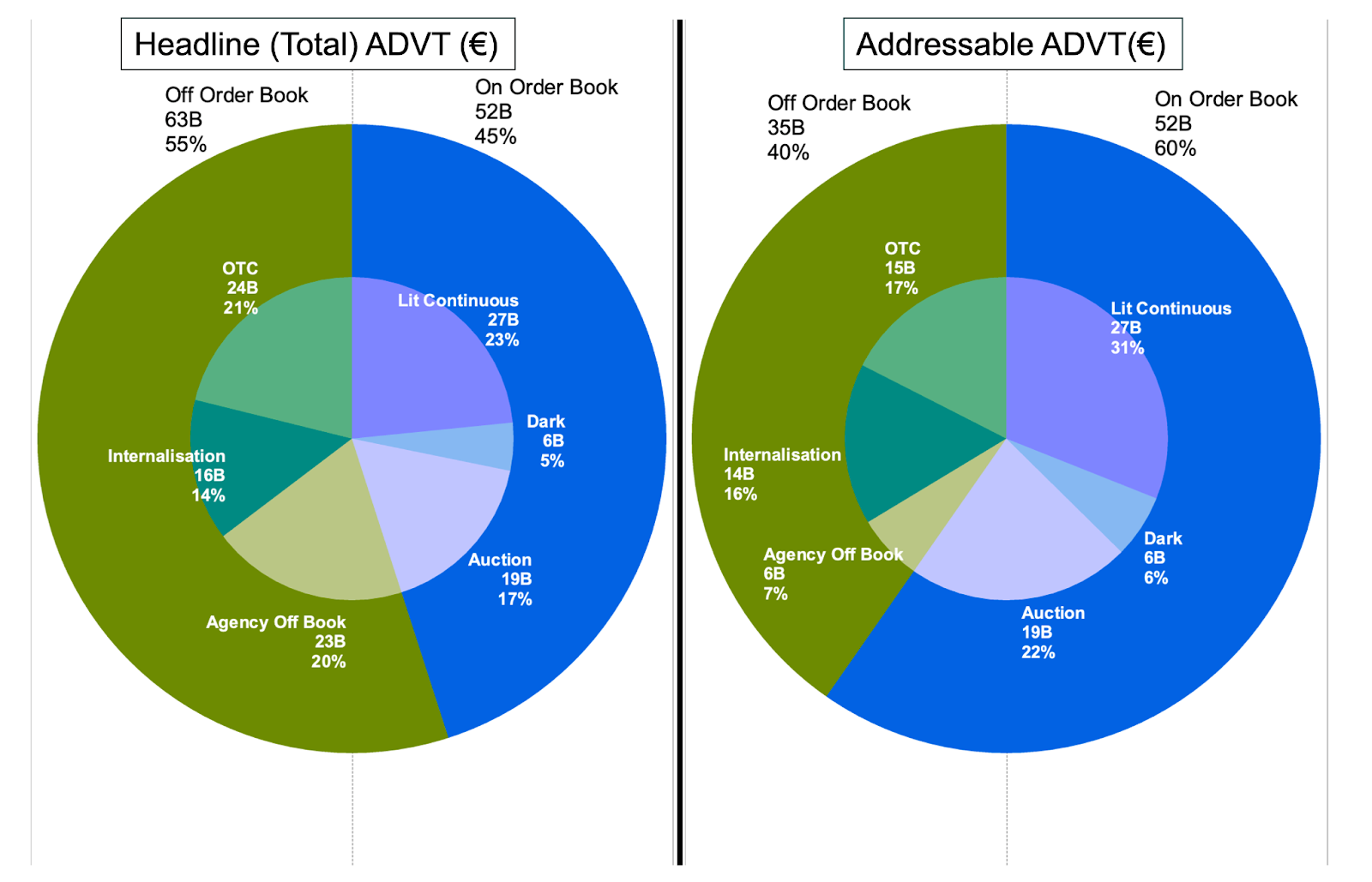
This substantial difference is found in the Off Order Book segment, where the market’s trade reports must be sifted and categorised to eliminate trades that do not interact with the market, and therefore neither contribute nor take liquidity, nor contribute to price formation. On Order Book trades do not require this treatment as they are produced directly by electronic matching engines using strict regulatory definitions. A further complication is that Off Order Book trades are published with up to a minute’s delay whereas On Order Book trades are published instantly.
How is Addressability defined?
Addressability refers to whether a given market participant can access a pool of liquidity systematically through automation, phone calls, chat or other mechanisms, with a reasonable probability of trading at a price which is at least as good as any other currently available in the market for a given size. Addressable liquidity is different for every participant because it depends on their technical setup (for example their access to electronic trading venues), network of brokers and market makers who can help them to find counterparties bilaterally or offer risk.
Why does the difference matter?
The difference between headline and addressable liquidity matters because a precise understanding of the size and reliability of liquidity is essential to avoid unexpected performance decay induced by implicit trading costs, especially during major events such as transitions, rebalances and substantial cash inflows and outflows. This is because estimates of trading impact, normally based on liquidity and its close relationship to volatility, are only as good as the predicted size of the liquidity available, measured through spreads and market depth. If trading costs are not accurately modelled, you may trade too fast, too slow, or with the wrong hedge. Consequently this affects returns performance and risk management. This also affects the quality of regulatory reporting as required under PRIIPS.
Therefore, liquidity should be ‘reliable’ in the sense that its size and distribution among different trading mechanisms and venues should be reasonably predictable with reference to recent history (normally 20 days). Non addressable liquidity should be eliminated from pre trade estimates, order routing strategies and post trade performance reporting.
How do we identify and measure addressability?
The blue-ish colours in the charts represent liquidity pools consistently available to everyone: in this case European Exchanges and MTFs, where multilateral, electronic trading takes place on a first-come, first-served basis, either continuously or in auctions. This is reliable, 100% addressable liquidity, that provides predictive value over ongoing liquidity availability provided that investors, through their brokers, have appropriate memberships and technical access to these venues. This landscape is constantly changing as venues innovate their services with new market mechanisms to try to capture liquidity from their competitors. Stakeholders in the industry must remain vigilant in following these trends to monitor whether their capabilities are up to date and can access these pools effectively.
The green-ish colours represent bilateral trades away from the Order Books of Exchanges and MTFs; between brokers on behalf of clients, market makers, or proprietary trading firms. These trades occur between two counterparties only, away from the competitive multilateral electronic venues. We have categorised these trades as ‘Internalisation’ (normally risk trades executed by investment banks) ‘Agency Off Book’ (cross trades between brokers on behalf of investors) and ‘OTC’ for everything else. Liquidity is more fragmented in these categories because trading is ‘bilateral’ and less visible. Every broker and market maker represents a potential pool of liquidity, which compels an investor to build and maintain a network of brokers and to invest in electronic RFQ and IOI mechanisms. Therefore, this type of liquidity is less reliable and not 100% addressable.
A firm must assess whether their execution is broadly distributed in line with the market share of all these liquidity pools in granular detail to gain an understanding of whether they are proportionately accessible to them for their needs, and if not be able to justify whether over-performance justifies a bias towards some pools more than others. In future episodes of Liquidity Matters we will dive into the details of the different types of Off Order book liquidity pools and explain their structure and measurement.
Why does a gap exist between Addressable and Non Addressable Liquidity?
All trades transferring beneficial ownership must be publicly reported. However, many are duplications or technical in nature and therefore do not contribute to price formation or provide a liquidity pool. These are highly varied in nature and can be very large. A common example is a ‘back to back’ trade where risk positions are consolidated into a single entity of an investment bank from its local dealing entities in other countries. These trades are classified in the Off Order Book category but in effect double count ‘real’ trading that has probably taken place earlier in the day in the local market. We must filter out this kind of trade to determine Addressability and sub-categorise Off Order Book trading to provide more visibility. This reclassification exercise produces the €28bn difference between headline figures and the more reliable Addressable Liquidity estimate.
Not all shares follow the same liquidity pattern.
Crucially, the picture varies significantly between shares; for example mid and small caps trade a larger proportion away from order books than in the case of large caps. This variation has material implications for portfolio construction and execution planning where inclusion criteria include liquidity thresholds. In the next episode of Liquidity Matters we will be looking at the measurement of trading cost by type of trading venue to investigate the relative cost of using different liquidity pools.
Taking Action
Precise measurement of Addressable Liquidity is a must have for investment and trading decisions and risk management. For precise measurement, xyt provides Addressable Liquidity Datasets for daily consumption. This provides high levels of granularity (symbol, sector, index, country etc) and is delivered through flexible access methods (via files, APIs or via our App) to help you explore or integrate Addressable Liquidity estimates into your internal workflows.
Follow us on LinkedIn to stay up to date with the latest series of Liquidity Matters, news and platform enhancements.