


Liquidity Matters Weekly Series
Click the links below to read the full blog series:
- Introducing Liquidity Matters
- Episode 1: Why Addressable Liquidity Matters
- Episode 2: The Cost of Liquidity
- Episode 3: Why Spreads Matter
- Episode 4: Why Expiry Dynamics Matter
- Episode 5: Alternative Closing Liquidity Matters
- Episode 6: Cross Asset ETPs Matter
Introducing Liquidity Matters
Financial markets operate through the medium of liquidity, enabling the efficient transfer of assets between buyers and sellers. The normal state of liquidity is asymmetric, ebbing and flowing continuously around an asset’s fair value until a supply and demand equilibrium appears.
Price is the conduit for this equilibrium, and the process is known as price formation; it is fuelled by competition, and benefits from market concentration and price transparency. High demand dictates a higher price, low demand a lower price. Thus liquidity and volatility are inextricably linked and in turn so are trading costs, risk and asset returns.
This is relevant to investors and issuers alike. A company may have great financial results, but if the shares are illiquid, investors require a higher risk premium and therefore a lower price.
Like fund managers, issuers care about liquidity too and work hard to maintain it in the market through corporate actions and other interventions. They also care about inclusion in indexes as they form the basis of investment vehicles (or products) that allow for passive investment of which many ETFs are created from. These investment vehicles increase liquidity and demand for their stocks, as we see during re-constitution events. Investors expect management to be aware of the liquidity in their shares.
Our Liquidity Matters series helps both generalists and specialists across all industry stakeholders to understand the market structure and its application to practical matters such as asset selection and trading, and highlights recent trends and notable events. Complexity in the market micro-structure, often referred to as the fragmentation of liquidity pools, presents challenges for managing trading costs and therefore asset returns, for accurate risk management and reporting. Our aim is to help clarify and summarise this complexity, using illustrations from our sophisticated data analytics and recent market observations.
Follow us on LinkedIn to follow the series.
Episode 1: Why Addressable Liquidity Matters
Headline trading volume figures routinely overstate the magnitude of liquidity available to investors, and by as much as €28bn euros per day in Europe based on 2025 data. This is 32% higher than the amount investors can reasonably rely upon for estimating trading costs and for investment decisions. The industry refers to the more precise notion of Addressable Liquidity. In this episode, we describe this concept and why it matters.
The discrepancy of 32% is illustrated in the chart below, which introduces the difference between ‘On Order Book’ trades (in blue) and ‘Off Order Book’ trades (in green). In this episode, we will expand upon this high-level definition of On and Off Order Book trading, which forms the foundational structure of the European equity microstructure as enforced by regulation.
The left chart shows headline volumes of €115bn Average Daily Value Traded ‘ADVT’; with just 45% traded on the order book. The right chart shows the adjusted number for Addressable ADVT of €87bn, with 60% traded on the order book.
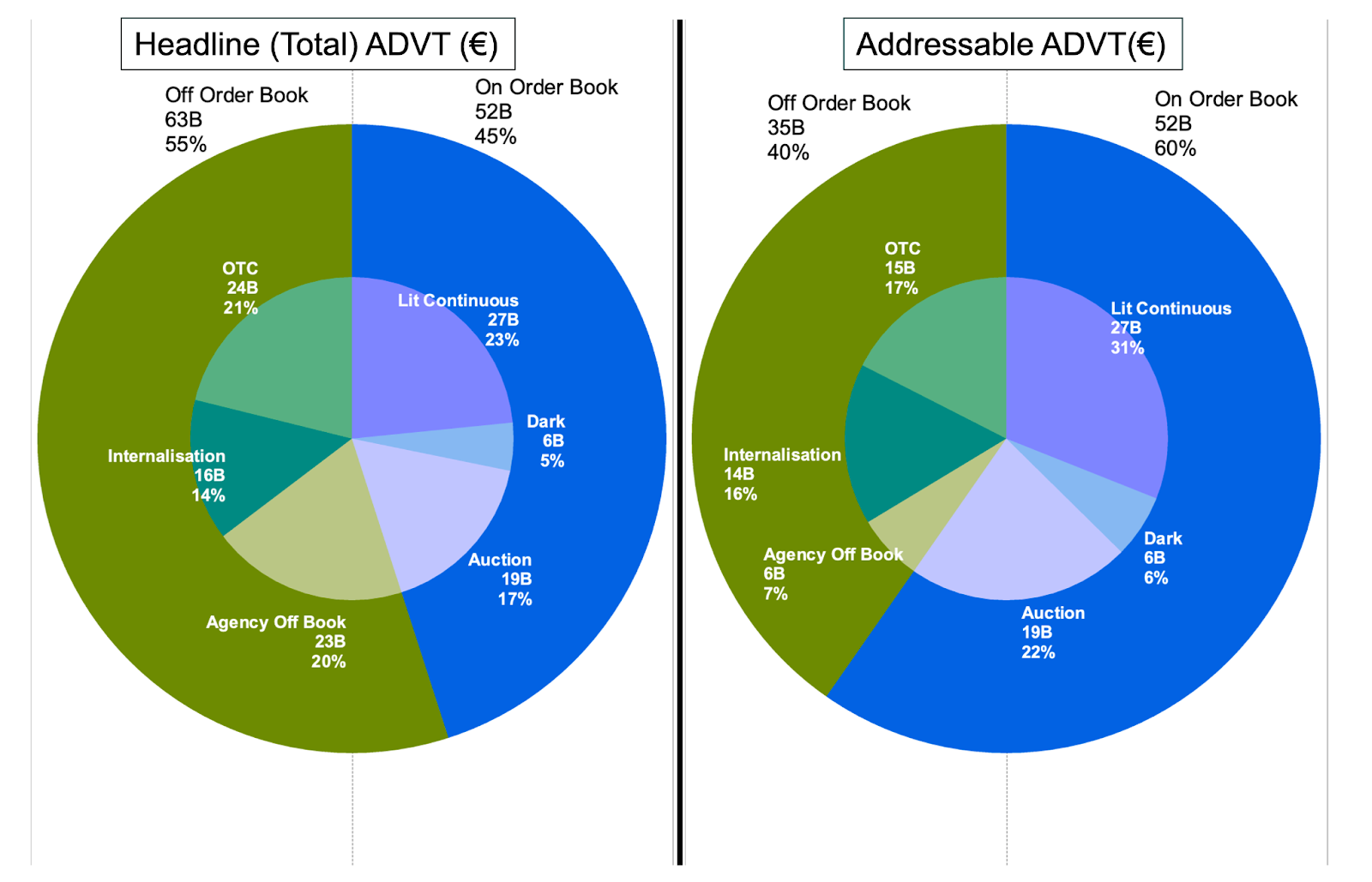
This substantial difference is found in the Off Order Book segment, where the market’s trade reports must be sifted and categorised to eliminate trades that do not interact with the market, and therefore neither contribute nor take liquidity, nor contribute to price formation. On Order Book trades do not require this treatment as they are produced directly by electronic matching engines using strict regulatory definitions. A further complication is that Off Order Book trades are published with up to a minute’s delay whereas On Order Book trades are published instantly.
How is Addressability defined?
Addressability refers to whether a given market participant can access a pool of liquidity systematically through automation, phone calls, chat or other mechanisms, with a reasonable probability of trading at a price which is at least as good as any other currently available in the market for a given size. Addressable liquidity is different for every participant because it depends on their technical setup (for example their access to electronic trading venues), network of brokers and market makers who can help them to find counterparties bilaterally or offer risk.
Why does the difference matter?
The difference between headline and addressable liquidity matters because a precise understanding of the size and reliability of liquidity is essential to avoid unexpected performance decay induced by implicit trading costs, especially during major events such as transitions, rebalances and substantial cash inflows and outflows. This is because estimates of trading impact, normally based on liquidity and its close relationship to volatility, are only as good as the predicted size of the liquidity available, measured through spreads and market depth. If trading costs are not accurately modelled, you may trade too fast, too slow, or with the wrong hedge. Consequently this affects returns performance and risk management. This also affects the quality of regulatory reporting as required under PRIIPS.
Therefore, liquidity should be ‘reliable’ in the sense that its size and distribution among different trading mechanisms and venues should be reasonably predictable with reference to recent history (normally 20 days). Non addressable liquidity should be eliminated from pre trade estimates, order routing strategies and post trade performance reporting.
How do we identify and measure addressability?
The blue-ish colours in the charts represent liquidity pools consistently available to everyone: in this case European Exchanges and MTFs, where multilateral, electronic trading takes place on a first-come, first-served basis, either continuously or in auctions. This is reliable, 100% addressable liquidity, that provides predictive value over ongoing liquidity availability provided that investors, through their brokers, have appropriate memberships and technical access to these venues. This landscape is constantly changing as venues innovate their services with new market mechanisms to try to capture liquidity from their competitors. Stakeholders in the industry must remain vigilant in following these trends to monitor whether their capabilities are up to date and can access these pools effectively.
The green-ish colours represent bilateral trades away from the Order Books of Exchanges and MTFs; between brokers on behalf of clients, market makers, or proprietary trading firms. These trades occur between two counterparties only, away from the competitive multilateral electronic venues. We have categorised these trades as ‘Internalisation’ (normally risk trades executed by investment banks) ‘Agency Off Book’ (cross trades between brokers on behalf of investors) and ‘OTC’ for everything else. Liquidity is more fragmented in these categories because trading is ‘bilateral’ and less visible. Every broker and market maker represents a potential pool of liquidity, which compels an investor to build and maintain a network of brokers and to invest in electronic RFQ and IOI mechanisms. Therefore, this type of liquidity is less reliable and not 100% addressable.
A firm must assess whether their execution is broadly distributed in line with the market share of all these liquidity pools in granular detail to gain an understanding of whether they are proportionately accessible to them for their needs, and if not be able to justify whether over-performance justifies a bias towards some pools more than others. In future episodes of Liquidity Matters we will dive into the details of the different types of Off Order book liquidity pools and explain their structure and measurement.
Why does a gap exist between Addressable and Non Addressable Liquidity?
All trades transferring beneficial ownership must be publicly reported. However, many are duplications or technical in nature and therefore do not contribute to price formation or provide a liquidity pool. These are highly varied in nature and can be very large. A common example is a ‘back to back’ trade where risk positions are consolidated into a single entity of an investment bank from its local dealing entities in other countries. These trades are classified in the Off Order Book category but in effect double count ‘real’ trading that has probably taken place earlier in the day in the local market. We must filter out this kind of trade to determine Addressability and sub-categorise Off Order Book trading to provide more visibility. This reclassification exercise produces the €28bn difference between headline figures and the more reliable Addressable Liquidity estimate.
Not all shares follow the same liquidity pattern.
Crucially, the picture varies significantly between shares; for example mid and small caps trade a larger proportion away from order books than in the case of large caps. This variation has material implications for portfolio construction and execution planning where inclusion criteria include liquidity thresholds. In the next episode of Liquidity Matters we will be looking at the measurement of trading cost by type of trading venue to investigate the relative cost of using different liquidity pools.
Taking Action
Precise measurement of Addressable Liquidity is a must have for investment and trading decisions and risk management. For precise measurement, xyt provides Addressable Liquidity Datasets for daily consumption. This provides high levels of granularity (symbol, sector, index, country etc) and is delivered through flexible access methods (via files, APIs or via our App) to help you explore or integrate Addressable Liquidity estimates into your internal workflows.
Follow us on LinkedIn to stay up to date with the latest series of Liquidity Matters, news and platform enhancements.
Episode 2: The Cost of Liquidity
Understanding where and how trades execute relative to the best available price is fundamental to managing execution costs. While our first episode explored the concept of liquidity pool addressability, we take the analysis deeper by examining the price premia associated with different types of trading venue. By measuring what proportion of trades execute at, inside, or outside the consolidated European Best Bid/Offer (EBBO), we can quantify trading cost differences between liquidity pools and make more informed decisions about where to route orders.
Using the EBBO, and a benchmark of the bid for a seller and the offer for a buyer, we can measure whether a liquidity pool offers a premium (or discount) for immediate liquidity versus current prevailing price. Deviation from the benchmark suggests increased (or decreased) liquidity cost and the analysis can be used to assess whether any execution bias towards one type of pool or another is justified.
As shown in the first chart, the ‘default’ position is the electronic intraday liquidity pool, consisting of the displayed and non displayed books and periodic auctions. This is the ‘most addressable’ intraday liquidity pool. As trade size is a determining factor for the liquidity premium, among others such as availability of liquidity and volatility, we use it to build a granular view of the premium across different types of liquidity pool.
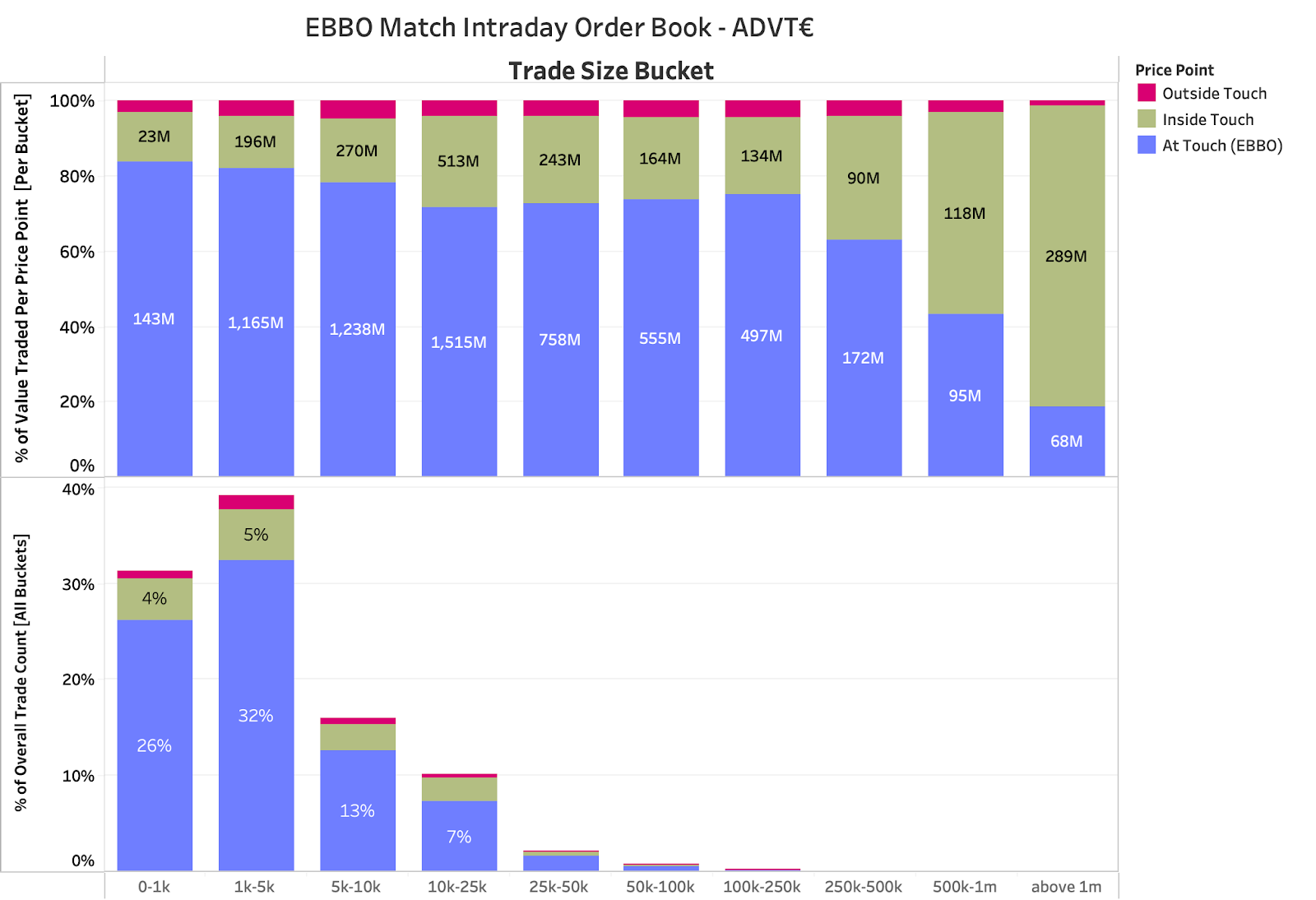
Figure 1: Distribution of trades by size buckets for European markets, March 2025 to January 2026. The upper panel shows average daily value traded in EUR at each price point. The lower panel shows the ratio of trades per price bucket at the given price point to all trades in all price buckets.
Figure 1 illustrates that over 96.5% of all trades fall into a size range below €25k, representing 61% of intraday order book liquidity. Of these, the proportion of trades executed at the EBBO is 77% with a further 19% falling inside the touch, with the latter being in periodic auctions and dark pools. This is a good demonstration of the value of these mechanisms in drawing order flow into the multilateral marketplace. On a value weighted basis across all buckets, 96% of trades pay no premium to EBBO, and of these 28% receive a discount. This underlines the importance of the electronic order books as not only the most substantial liquidity pool but also the most reliable, even at larger sizes.
But why not 100% for all order sizes? Owing to the fragmentation of the order books, latency in order routing means it is possible for an aggressive order to be ‘in flight’ on its way to one trading venue when a better price simultaneously appears on another venue. Secondly an order that ‘drills the book’ by taking more than one price level without reference to prices on other venues may fall outside EBBO. Maybe it is more surprising that this figure (less than 4% of all trades) is not higher. It is a sign that the market is efficient in respect of order routing and dealing with latency. It is not shown in the chart but curiously, the phenomenon affects buy orders more than sell orders (let us know if you want the details).
Next we move to the Off Order Book liquidity pools, depicted in the second chart. As discussed in Episode 1, these liquidity pools are less addressable as they depend on an investment firm’s access to a network of brokers or market makers and their IOI/RFQ setup.
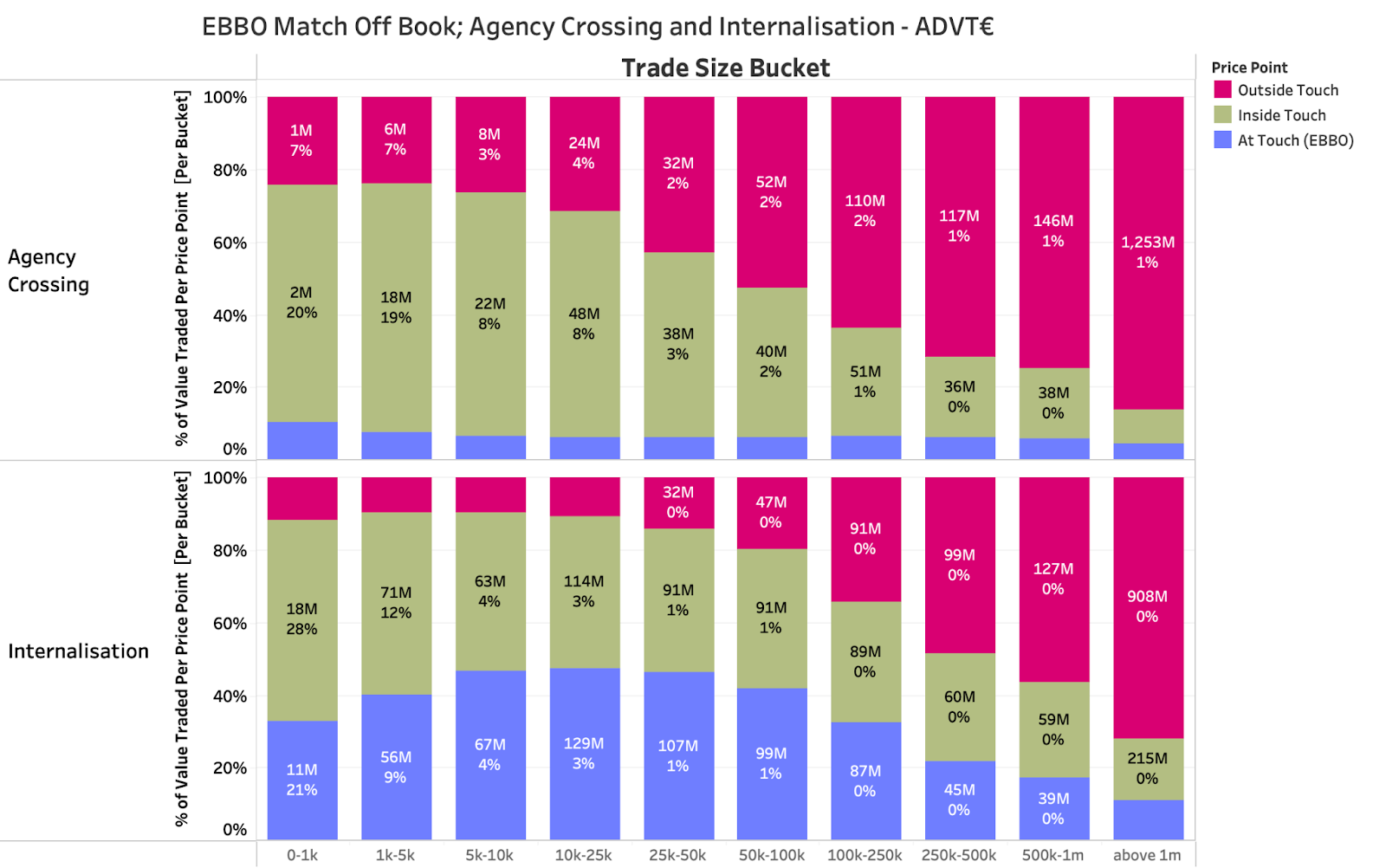
Figure 2: Distribution of trades by execution price point and by size buckets for European markets, March 2025 to January 2026. The label in both panels depicts the average daily value traded in EUR per price point and ratio of all trades executed in a given size bucket to the overall number of trades.
First, a caveat; Off Order Book trades must be reported by a market participant (as opposed to an electronic trading venue) via a trade reporting facility. The time limit set by the regulators to submit a report following a trade is one minute. This means analysis of these trades suffers a time lag to the EBBO, although much of the reporting is automated and instantaneous, particularly in the case of internalisation. This is noticeable in that 29% of trades are executed outside of the EBBO benchmark in the Agency Crossing category and 12% in the Internalisation category, compared with only 4% for the Order Books. Using a time window of one minute as a tolerance for EBBO will significantly reduce this effect - such a tool is available in our Best Execution analytics service.
Nevertheless, Agency Crossing and Internalisation liquidity pools demonstrate very high levels of EBBO price improvement with 50% of trades executed inside the touch - a significant liquidity discount and more than the Order Books at 19%. Of course, these two Off Order Book liquidity pools account for only 16% of smaller trade sizes executed on the Order Books, an indication of the proportion of trades that could be potentially drawn back into the Order Book if spreads were tighter.
When we scale up the trade size bucket to look at trades above €500k, we find that trading in these two liquidity pools is 5.4x more than that of the Order Books by value, as would be expected. The proportion executed outside of EBBO is 77.5% which indicates that these are trades where prices may be manually negotiated and where the reporting latency is a significant factor.
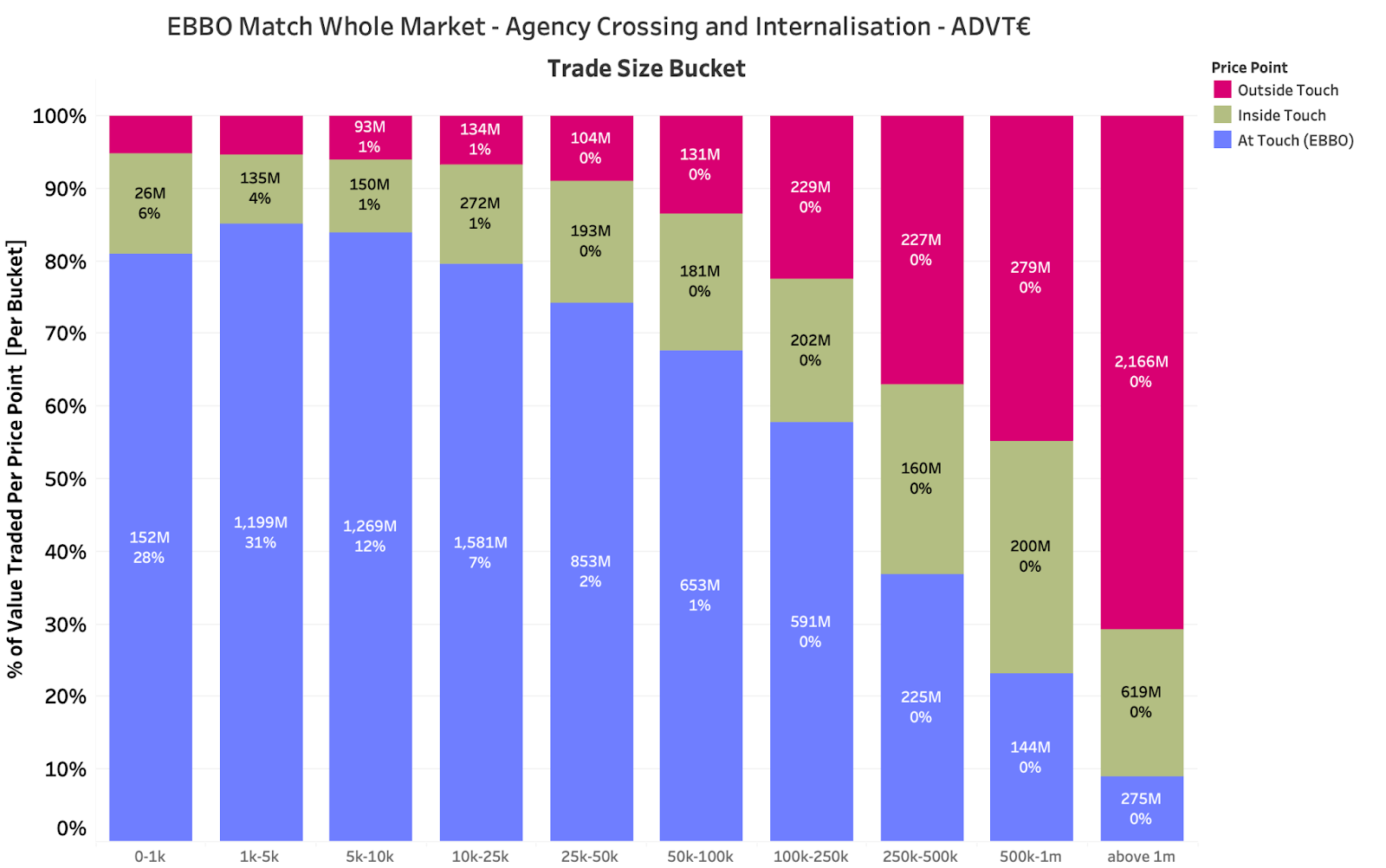
Figure 3: Consolidation of all trade categories, On Order Book and Off Order Book, March 2025 to January 2026.
Figure 3 brings together the first two charts to give a consolidated view of the whole market showing that the bigger the trade, the higher the liquidity premium, as expected. The data reveals a clear hierarchy in execution quality across liquidity pools. Intraday order book trading delivers the most consistent EBBO execution for small and medium sized trades, while Off Order book liquidity pools offer greater price improvement through mid-point matching, but for a smaller pool of liquidity.
For larger trades, the picture shifts considerably, with negotiated executions and dark pools playing a dominant role despite higher apparent deviation from EBBO benchmarks. These findings underscore the importance of precise monitoring and demonstrate that execution strategies should be calibrated not just to trade size, but to the specific cost characteristics of each type of liquidity pool and each trading venue. Investors can compare their own trading results to this overall summary of the market to identify the strengths and weaknesses of their routing strategies.
In our next episode of Liquidity Matters we will extend this analysis to examine whether the quality of a liquidity pool is durable, i.e. whether the premium paid for immediate liquidity erodes over time as price evolves, or increases.
Follow us on LinkedIn to stay up to date with the latest series of Liquidity Matters, news and platform enhancements.
Episode 3: Why Spreads Matter
Understanding the cost of immediate liquidity is essential for both trade planning and post-trade analysis. The quoted bid-ask spread is commonly used as a proxy for this cost—but how reliable is it?
For Europe's most liquid large-cap stocks, headline spreads range from around 3.5 basis points in Paris to 5.5 basis points in London. This roughly reflects what a retail investor pays for immediate execution on a small trade, say €5,000. It's also close to what institutional investors end up paying when they break larger orders into smaller pieces.
But here's what makes the spread less useful as a benchmark: only 52% of trades are €5,000 or smaller, and just 76% fall at or below €25,000. For nearly half of all trades, the quoted spread may not accurately reflect the true cost of execution.
When you account for size distribution, a different picture emerges. The spread at €25,000 is roughly 25% wider in Paris (4.4 basis points) and 35% wider in London (7.4 basis points). This is the spread premium—essentially, the additional cost of accessing liquidity in larger sizes. For a large-cap fund with €50bn under management that reweights 10% of holdings annually whilst accommodating 10% gross inflows and outflows, this gap translates to around €4.4m per year, leaking away from returns. That's not trivial.
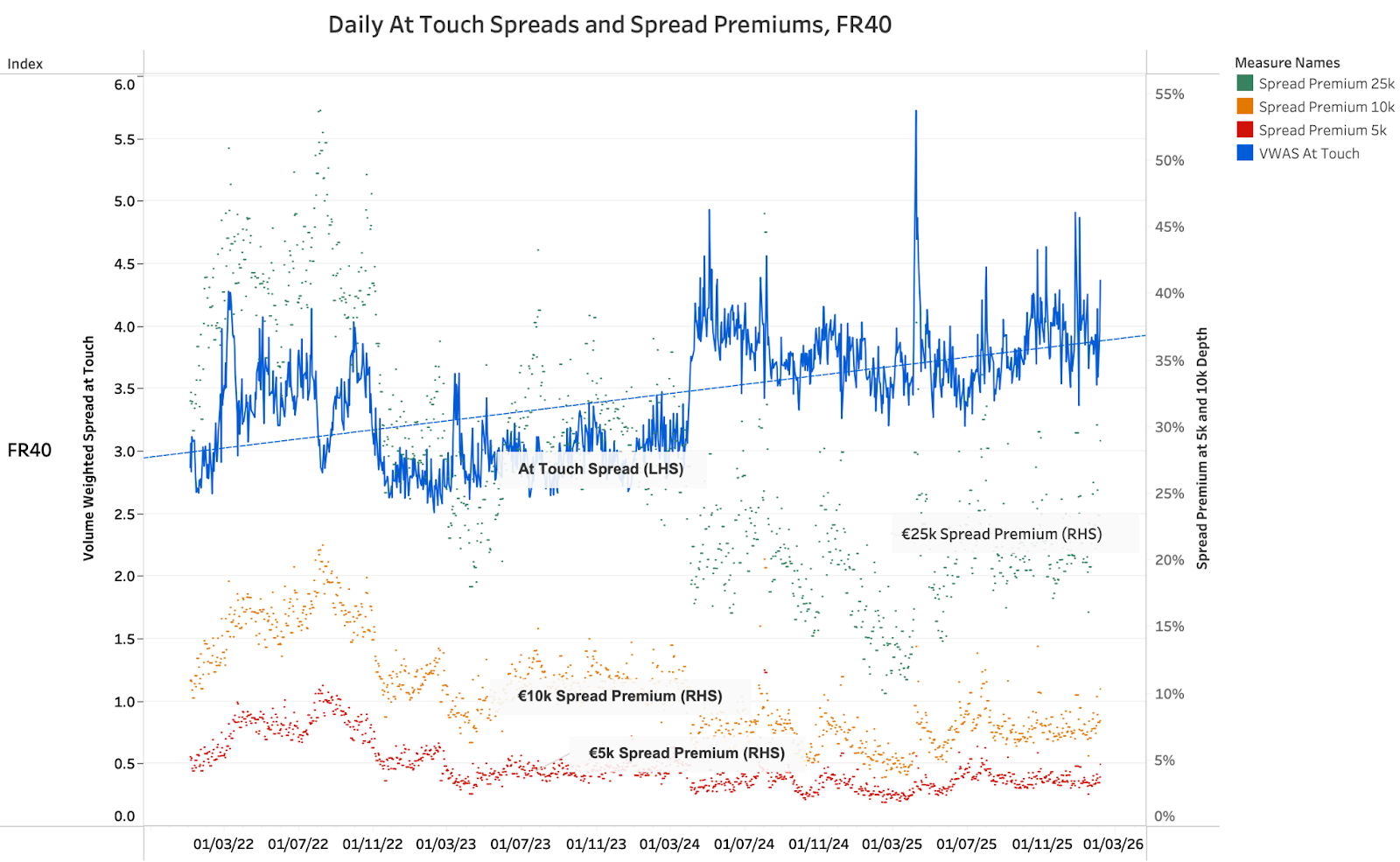
Figure 1: At Touch Spreads and various spread premiums for the FR40 since 2022. For methodology see notes below.
Looking at the chart, the at-touch spread (blue) appears highly volatile, and trending upwards wider. When market volumes are subdued and volatility is muted as in the volume drought of 2023 and early 2024, spreads decrease. This is counterintuitive, as we might imagine that the greater the liquidity available, the tighter the spreads. Yet despite these fluctuations, outside of sharp volatility spikes, the at-touch spread remains fairly bounded and therefore reasonably reliable as an anchor for predicting costs. The €5,000 spread premium (red) is very stable below 0.5 basis point, reflecting that the order book nearly always has capacity for such trades. This is also true of the €10,000 spread premium (yellow) which adds another 0.5bps and is a dependable guide for 52% of trades.
At €25,000, the premium (green) grows quickly, adding up to 4bps in 2025, and indicating that the book may not be liquid enough for the 7% of trades reaching these size levels.
This is where two distinct components of the quoted spread become visible. There's the explicit cost, the direct charge for execution and settlement which is highly predictable and implicit cost, which is the reward dealers and passive traders demand for providing liquidity. When markets are settled, this reward can remain relatively modest. When they're unsettled, it must rise.
The gap between the €5,000 premium and the €25,000 premium appears to capture something of this implicit pricing for volatility. What's striking about the €25,000 premium is that it doesn't move randomly. It clusters, it persists, it shows memory. It's correlated with volatility regimes, but it doesn't simply flip in and out, it stays elevated during stressful periods and takes time to recede. This is vital for understanding the additional costs of trading during and after volatile periods, which should feed into your trading decisions.
When Market Microstructure Changes
A highly revealing moment in this chart comes in April 2024. Before that date, the €25,000 premium drifts gradually upward, but from the 2nd onwards, there's a distinct shift in the baseline. The at-touch spread becomes noticeably more volatile, and the premium sits persistently higher. In fact, it did.
ESMA's quarterly tick size reclassification in early April recalibrated the minimum price increment for French large-caps, effectively widening the tick grid. Dealers immediately adjusted their quoting behaviour to this new constraint, and the cost of accessing depth appears to have settled into a higher equilibrium. This is where regime shifts become particularly awkward for practitioners.
Any backtesting model calibrated on pre-April data will systematically underestimate transaction costs going forward. The historical relationship between volatility and spreads, so carefully fitted to the 2022-2024 period, no longer holds. Whether this new regime proves permanent or cyclical remains to be seen, but the lesson is rather pointed: the past is a less reliable guide when the microstructure changes.
This has real implications for how we measure trading costs. Average spread data feeds directly into pre-trade cost models, which in turn shape decisions about execution speed, timing, and algorithm design. The same data informs asset selection and regulatory liquidity reporting under frameworks like PRIIPS.
Choosing the right metric for your trading activity isn't simple. The data is vast with billions of data points daily, expensive to capture, maintain, and refine. But if better measurement saves you €4.4m a year, the investment pays for itself.
Follow us on LinkedIn to stay up to date with the latest series of Liquidity Matters, news and platform enhancements.
Episode 4: Why Expiry Dynamics Matter
Derivatives and equity markets are inherently connected. Index contract expiries drive substantial surges of liquidity into equity markets, particularly during the end-of-day auction on expiry day.
The biggest single liquidity event for 2025 in equities was the closing auction coinciding with Index Futures Expiry on September 19th, €46 billion, equal to an entire day's worth of annualised order book ADVT. This is a regular, deep, and predictable liquidity pool for equity traders to tap into. Open Interest in the FTSE100 ICE contract alone currently stands at over €45 billion.
Open Interest data provides insights into equity flows. It consists of the aggregate position of distinct participant types: CTAs with unhedged exposure to futures prices, real money managers using futures to hedge their underlying equity strategies, delta-one desks and APs managing tracking error and reconstitution, among other activities that keep an index and its underlying in sync. This reflects risk sentiment—higher Open Interest and higher contract volume indicate higher volatility. On expiry, the aggregate position must be closed through the combined actions of participants: offsetting futures positions, rolling into the next contract period, or settling and unwinding any hedge, facilitated by liquidity providers. These dynamics are directly connected to the equity market and trigger very high volumes, especially during expiry day closing auctions.
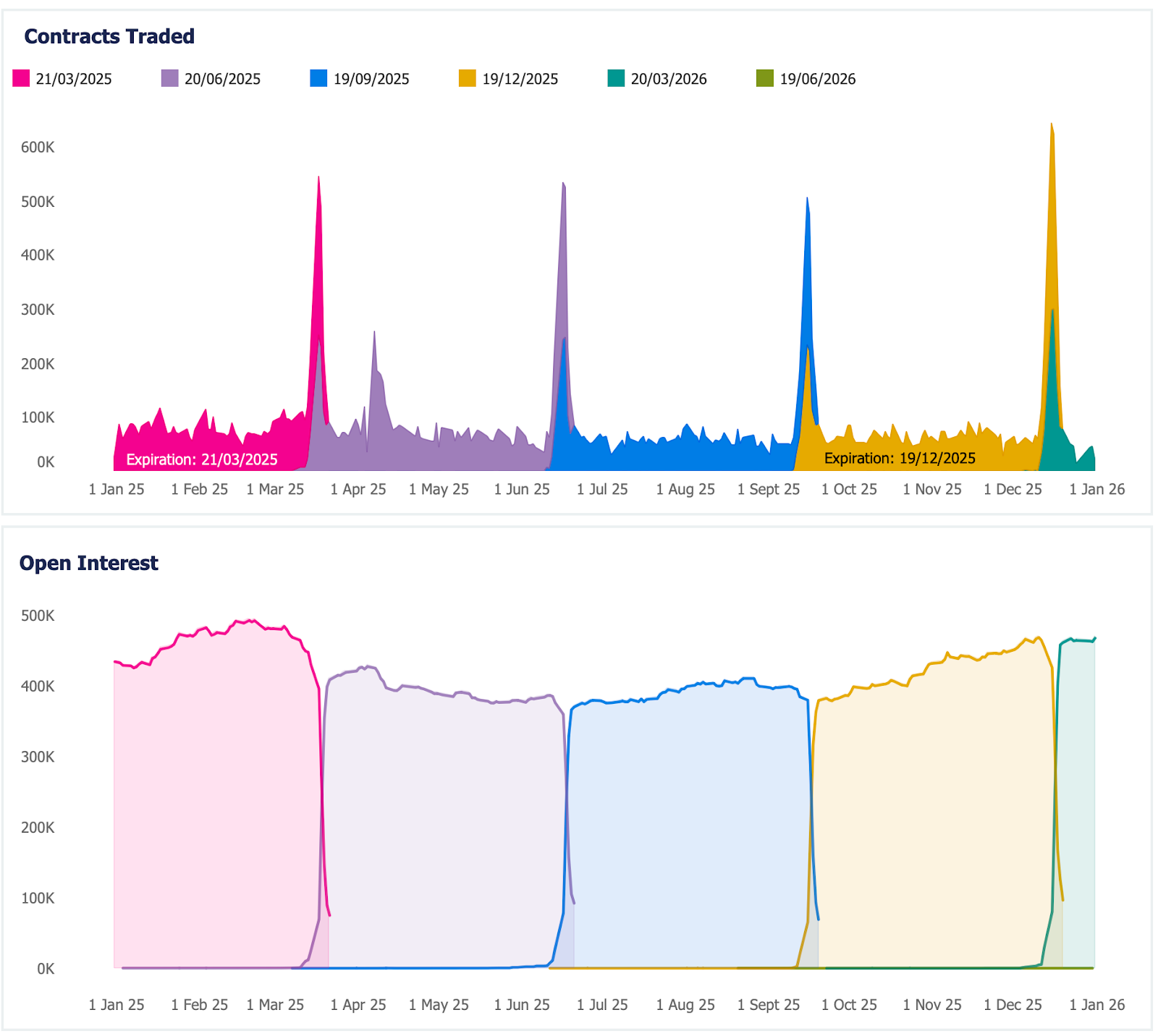
Figure 1: Z/25 Start of Day Open Interest and trading volume on ICE. June and September OI value was muted; June OI declined steadily from initial rolled value to expiry, while December showed the opposite.
Figure 1 shows the quarterly FTSE100 Index Futures contracts for 2025. 'Start of Day' Open Interest is higher in the first and fourth quarters, apparently tracing market volatility. There's a drop of 60,000 net contracts following the March expiry—indicating a lower roll (c80%) compared to higher roll percentages in the other three expiries.
The direction and persistence of Open Interest is reflected in the average time between the 'peak day' for Open Interest and expiration: 58 days across all contracts, with wide variation from 9 days in the December contract to 77 in the June contract. A higher number implies reducing volatility. Keeping track of this measure indicates potential roll volume and whether Open Interest is building or reducing towards expiry.
The corresponding equity market closing auction volume is another key measure, ranging from €39 billion in December to €46 billion in September as the index is reconstituted at the close.
The Roll pattern is consistent, but timing varies. It normally starts between five and ten days out from expiry. Back-contract Open Interest rises slightly at first, announcing the start of the Roll, which then accelerates fast during the last week of trading. Equity liquidity deepens as participants trade the underlying to stay hedged into expiry day and the 10:15am fixing.
Equity traders can use cross-asset data to monitor trends in the flows and build an additional layer into their liquidity management framework for pre-trade estimation, trading strategy selection, and operational models such as intraday volume curves and close auction prediction. Liquidity deepens at regular monthly and quarterly expiries, creating windows of opportunity for lower-cost rebalancing, transitions, and equitisation of inflows and outflows. This is why the expiries matter.
Follow us on LinkedIn to stay up to date with the latest series of Liquidity Matters, news and platform enhancements.
Episode 5: Alternative Closing Liquidity Matters
Institutional traders relying solely on primary exchange closing auctions for end-of-day trading may be missing out on up to €4.4 billion per day available through alternative liquidity pools. In 2025, 'at close' liquidity accounted for €15.2 billion per day - 22% of market volumes across Europe. Closing auctions accounted for only 16% of market volumes, or €10.8 billion per day. The alternative pools offer up to 29% more liquidity than the closing auction alone.
Why Closing Liquidity Matters
For traders using NAV and MOC benchmarks, the Close represents the opportunity to execute all or part of a trade with zero tracking error, to reduce overall market impact by minimising residual quantities that must be executed before the close, and to avoid gap risk. The additional liquidity pools offer the chance to optimise this opportunity.
Figure 1 shows the daily comparison of all available liquidity (including the closing auction) and alternative pools (excluding the closing auction) in 2025. In the previous episode of Liquidity Matters, we demonstrated how futures expiries drive very high spikes in at-close flows. The subject of alternative liquidity pools also links to these events.
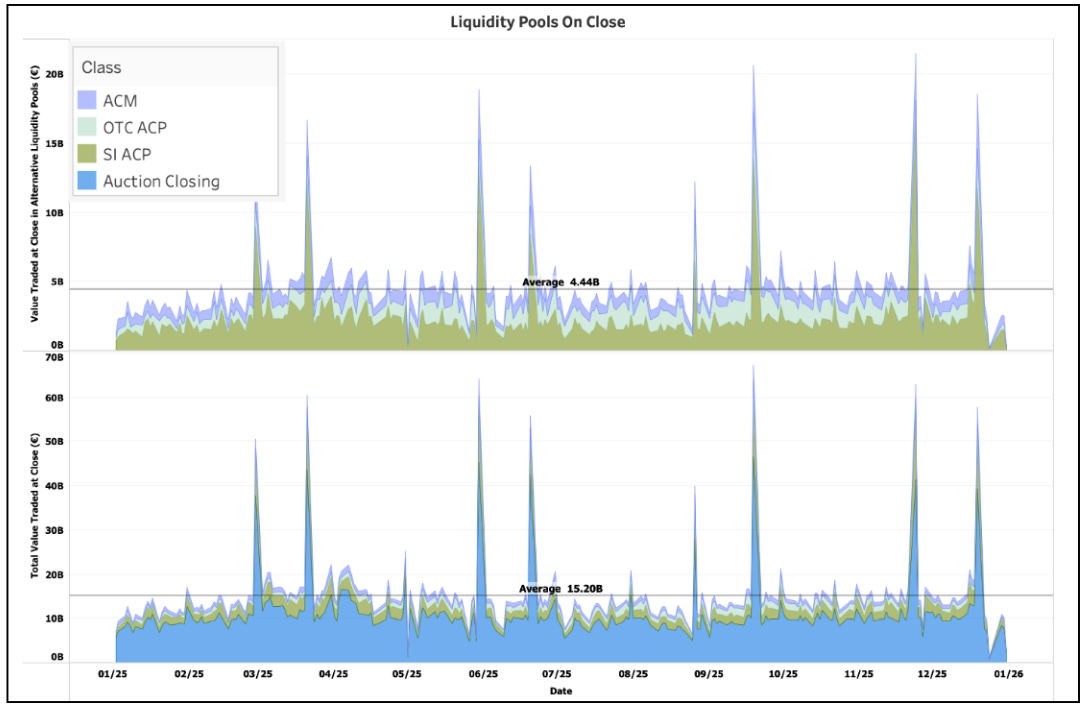
Figure 1: The lower panel shows all 'at close' liquidity pools, including the primary exchanges' closing auction period. The upper panel excludes the primary Closing Auction. The average difference in 2025 was €4.4 billion per day (29%).
Consider a €20 million trade in a liquid stock. If the primary closing auction averages €17 million daily, a 20% participation cap limits primary execution to €3.4 million. The remaining €16.6 million must be executed intraday or through alternative closing pools. Using our headline figures (bearing in mind the ratios change from stock to stock), by accessing alternative closing liquidity pools, the trader can route an additional 6.5% of the overall trade to alternative close liquidity pools, improving execution quality and reducing overnight position exposure. This shift in execution timing directly reduces tracking error to the NAV or MOC benchmark.
Where is the Additional Liquidity Found?
Alternative closing liquidity divides into three categories:
-
Alternative Closing Mechanisms (ACMs): €900 million daily (1.3% of daily volumes)
MTF and exchange-operated electronic platforms execute the equivalent of 8.3% of primary closing volume. These are fully addressable through brokers with the required market access. ACMs operate in two formats: parallel-timed mechanisms synchronised with primary auctions (lower fees, same closing price), and post-close platforms that capture residual quantities after primary price discovery. All execute at the primary closing price, preserving the primary auction as the price-formation venue. - Systemic Internalisation at Close (SI 'At Closing Print'): €2.4 billion daily (3.5% of daily volumes)
Banks and liquidity providers execute bilateral trades at the primary closing price away from order books. - Over-the-Counter at Close (OTC 'At Closing Print'): €1.2 billion daily (1.7% of daily volumes)
This consists of negotiated bilateral closing trades not classified as bank internalisation. These flows typically involve large block trades where price is negotiated directly between parties.
Together, SI and OTC account for €3.6 billion daily, equivalent to 33% of primary closing auction volume and 5.3% of overall daily market turnover. As these mechanisms are bilateral, they are not 100% addressable. Investors gain market access through their broker networks, investment in IOI/RFQ technology, and ongoing relationships with risk providers.*
Implementation: The Critical Questions
Access to alternative closing liquidity requires systematic answers to three questions:
-
Does your broker network provide sufficient execution access to ACMs and bilateral closing flows?
-
Does your pre-trade execution model account for closing volume across all pools, or only the primary auction, and is it properly calibrated at stock level?
-
Does your post-trade analysis capture execution rates across all closing pools?
The answer to these questions lies in an investor’s capabilities in measuring trading volume distribution (for example primary vs. ACM vs. bilateral) and execution quality (for example benchmark slippage) at the level of individual liquidity pools and venues.
Conclusion
The €4.4 billion in daily alternative closing liquidity is not marginal. For trades benchmarked to NAV or MOC, systematic access to these pools can reduce intraday market impact, tracking error, and gap risk.
However, capturing this opportunity requires acquiring, processing, and classifying very high volumes of data at stock level, billions of data points a day. It demands sophisticated pre-trade models and post-trade analytics, and optimised market access, whether directly or through brokers, for ACMs and bilateral flows. Without these capabilities, investors may miss the opportunity to optimise their trading costs.
Follow us on LinkedIn to stay up to date with the latest series of Liquidity Matters, news and platform enhancements.
*Categorisation of off order book trades into bi-lateral buckets requires detailed examination of trade reports. Using the industry standard ‘MMT’ (Market Model Typology) we condense all trade reports by filtering out trades that are reported as ‘non price forming’ or ‘technical’ or with a price that does not precisely match the official close.
Episode 6: Cross Asset ETPs Matter
The ETP ecosystem, spanning equities, commodities, REITs, fixed income and more recently crypto, has become the real-time window into investor sentiment and how capital is repositioning itself across asset classes with varying risk exposures. Trading volumes and changes in assets under management (AUM) reveal sector rotations, assets exposures, and liquidity constraints as they happen.
This granularity has the advantage over mutual fund data, which suffers heavy time lags. Unlike quarterly mutual fund surveys, ETF flows are timely signals of where capital is moving and which asset classes are facing execution pressure. This is an essential tool for determining asset allocation and diversification.
For example, holdings in European Gold ETPs have grown by over 90% since January 2025; silver equivalents have more than doubled. January 2026 revealed increasing bearish sentiment on the metals and concerns about an AI bubble (gold and silver are used heavily in chip manufacturing) which triggered an historic 44% drawdown in silver and a 15% temporary slide in gold prices. Figure 1 shows the extreme reduction in asset values in January followed by a reversion to the trend.
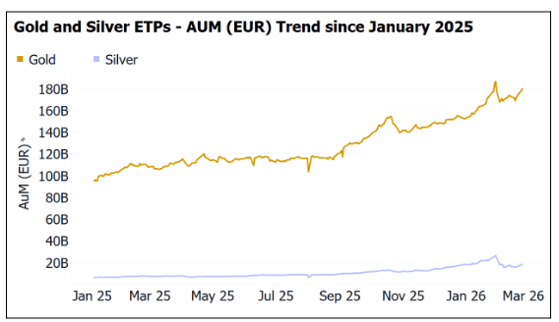
Figure 1: Daily Changes in AUM for European Gold and Silver ETPs since January 2025.
Figure 2 shows daily trading activity in European ETPs for equities, commodities and fixed income since the beginning of 2025, with gold and silver growing fast since September 2025, reaching a peak at the end of January. What does this mean for measuring investor sentiment? Traditionally, commodities have been viewed as a hedge against inflation (opinion is divided). But inflation is reducing. Is the longer term connection between gold investment through ETPs a bullish take on the AI revolution, or a risk-off hedge for the bubblists?
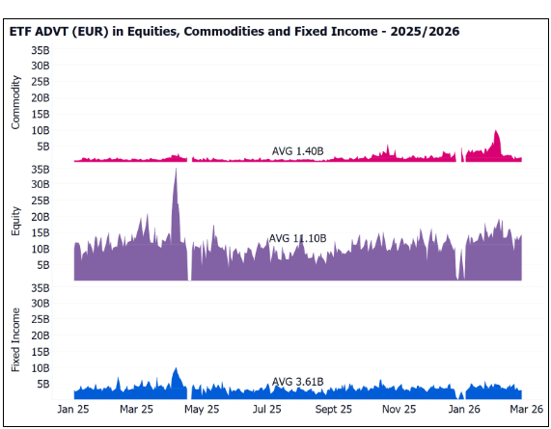
Figure 2: Daily Traded Value in European ETPs since January 2025 showing strong growth in Commodities since September 2025.
Pause for thought - both bulls and bears chasing the same asset class sounds like a regime change - volatility caused by the push and pull of different use cases for the asset. This demands careful consideration for portfolio managers using these assets as signals. Even for portfolios that don’t invest in commodities, their prices impact equities and fixed income products. Market volumes help to understand the dynamics behind the price and ETPs represent a powerful proxy for following the trend.
Historic and intraday information on ETF volumes, backed up with creation/redemption information allows portfolio managers to track trends across asset classes over multiple years and granular periods. It can identify sizable institutional switch strategies on a daily basis, and momentum in investor sentiment shifts. It can be used to pick out trends in retail attitudes to risk and help traders understand the rapid evolution in market structure that accompanies the ETP ecosystem. This helps to plan and implement execution strategies and measure execution quality, through the monitoring of trading costs across different venues types such as RFQ venues and lit order books.
Our primary and secondary ETF market data provides insights into peer group rankings, trends in asset classes that support product development and provide deeper analysis into trading and execution strategies. For more information on our ETF data and analytics, contact sales@xyt.one.